 Listicle
7 Best Practices for Airbnb Supply Restocking
Last Updated: November 12, 2026
Quick Summary
Airbnb supply restocking means keeping every consumable and amenity at a set minimum so a unit is guest-ready after each turnover. Hosts do this by building a master checklist, setting par levels, labeling storage, tracking usage, and running a fixed restocking routine.
- Build one master checklist of every consumable and amenity, sorted by room.
- Set par levels, such as 12 toilet paper rolls for a two-bedroom unit hosting four guests.
- Track usage in a spreadsheet with reorder points tied to supplier lead time.
- Restock within a fixed turnover routine, handing the same checklist to any cleaner.
- Track restocking cost per occupied night and check quality after every turnover.
Table of Contents
- 1. Build a Master Restocking Checklist for Every Room
- 2. Set Par Levels With Example Quantities
- 3. Organize Supplies by Room and Label Every Storage Spot
- 4. Track Usage in an Airbnb Supply Tracking Spreadsheet
- 5. Restock Between Guest Stays With a Set Turnover Routine
- 6. Budget for Restocking and Track Cost Per Stay
- 7. Check Quality After Every Turnover and Plan for Shortages
- Putting the Airbnb Supplies List Into Practice
- Frequently Asked Questions
Airbnb supply restocking between guests sounds simple until you find an empty toilet paper roll at 11 p.m. or a guest asking for a second bath towel. Most hosts learn the hard way that a good supply system prevents those problems before they happen. The same seven practices show up again and again among hosts who keep their rentals guest-ready. Airbnb supply restocking works best when you plan the supplies, set minimum quantities, and check results after every turnover.
Below, we walk through each practice step by step, with example quantities and a routine you can copy. Use it as a checklist the next time you prepare a unit.
1. Build a Master Restocking Checklist for Every Room
A master checklist is a single list of every consumable and amenity in the property, sorted by room. Start with the bathroom, kitchen, bedroom, and common areas. Then add the items guests expect, such as toilet paper, hand soap, coffee pods, dish soap, and clean linens.
Write down each item, its location, and who restocks it. Keep the list in one shared place, such as a printed sheet in the storage closet or a shared document your cleaner can access. A checklist turns restocking from memory into a repeatable routine.
2. Set Par Levels With Example Quantities
A par level is the minimum number of each item you want on hand at all times. When stock falls to the par level, you reorder. For a two-bedroom unit hosting up to four guests, a workable starting point looks like this:
| Item | Par Level | Reorder When | | --- | --- | --- | --- | | Toilet paper rolls | 12 | Stock drops to 6 | | Hand soap refills | 3 | Stock drops to 1 | | Coffee pods | 30 | Stock drops to 10 | | Dish soap | 2 | Stock drops to 1 | | Bath towel sets | 8 | Stock drops to 4 |
Par Level
These numbers are examples. Adjust them based on how many guests you host and how long their stays usually last. Track real usage for a month, then update your par levels. The goal is to keep enough on hand without overbuying.
3. Organize Supplies by Room and Label Every Storage Spot
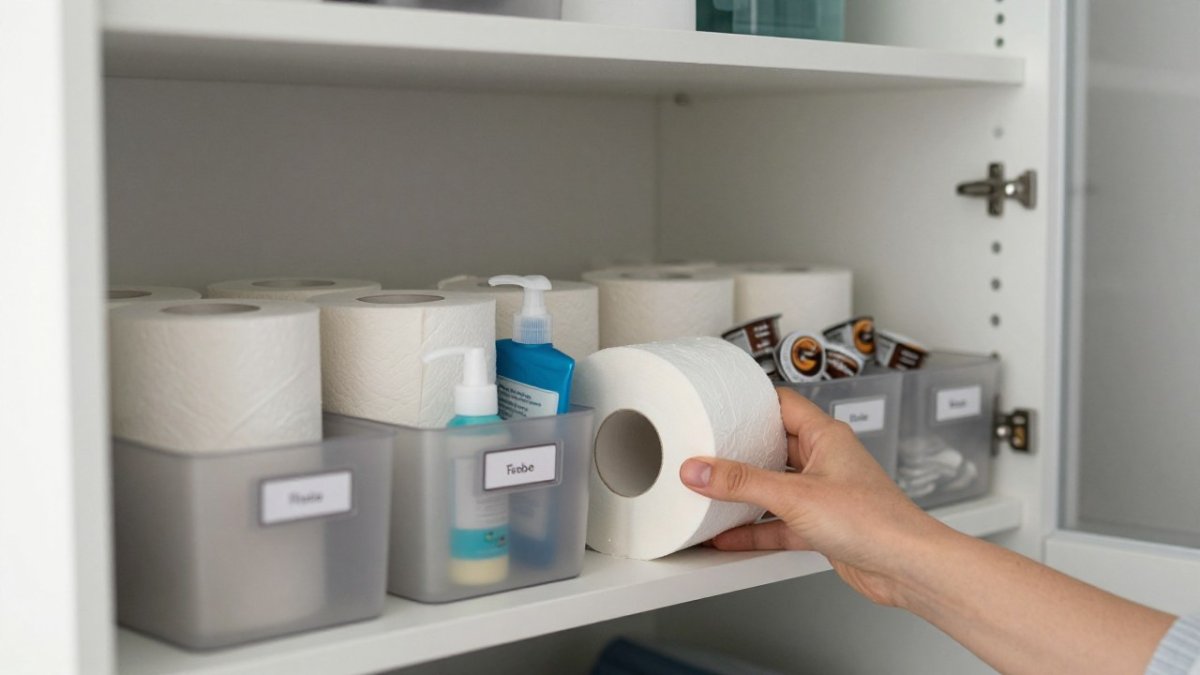
Organized storage saves time during turnovers. Keep bathroom supplies together, kitchen supplies together, and linens in one closet. Use clear bins or baskets and label each one with its contents and par level.
Labels matter most for anyone who isn't you. A cleaner or co-host should be able to find a spare roll of toilet paper in seconds. Store backup stock on a higher shelf or in a separate bin so the everyday supply always stays visible.
4. Track Usage in an Airbnb Supply Tracking Spreadsheet
A spreadsheet is only useful if it tells you when to buy, not just what you bought. Build it so the count itself triggers the reorder. Set up one tab per property with these columns: item, room, par level, reorder point, current count, units per case, supplier, lead time in days, last restocked date, and a calculated "units to order" cell.
The reorder point is the number that matters. Set it at the quantity you use during your supplier's lead time plus a safety buffer. If a case of toilet paper takes five days to arrive and you go through about one roll per guest night, a reorder point of six rolls covers a five-night booking plus a buffer. When current count hits that number, the sheet should flag the row.
Use a simple conditional format so any row where current count is less than or equal to the reorder point turns red. Add a second flag for rows where current count is below par level but above the reorder point, those are your "order on the next bulk run" items, not emergencies. This two-tier system is the practical version of low-stock alerts, and it works in any spreadsheet app without paid inventory software.
Feed the sheet from the turnover, not from memory. Have the cleaner or co-host record counts on a short end-of-turnover form, one line per item, with a column for "used" and a column for "damaged or missing." Enter those numbers into the sheet the same day. A common pattern is to reconcile counts weekly and place orders on a fixed day, so purchasing becomes a batch task instead of a series of emergency store runs.
Watch out: if the person counting is also the person ordering, counts drift toward whatever justifies a convenient order. Have a second person spot-check a handful of high-turnover items, toilet paper, coffee, bath towels, once a month against the sheet.
Over a few months the sheet shows patterns. You might find soap use doubles in summer or that family stays burn through paper towels faster. Use those patterns to reset par levels and reorder points rather than guessing each season.
5. Restock Between Guest Stays With a Set Turnover Routine
Restocking works best as part of a fixed turnover routine. Follow the same order each time: strip and replace linens, clean, then restock every item on the checklist before the next guest checks in. You can also see how to schedule turnovers step by step around guest stays.
Many hosts restock in the room where the item is used. Walk through the unit with the checklist in hand and mark each item as complete. If you hire help, give the cleaner the same checklist so the result stays consistent.
6. Budget for Restocking and Track Cost Per Stay
Restocking has a real cost, and the only way to control it is to measure it per occupied night rather than per month. The formula is simple: total supply spend divided by occupied guest nights for the same period. If you spent $180 on consumables across 30 occupied nights, your cost per occupied night is $6.00. Track that number monthly and compare it to your cleaning fee and nightly rate.
Build the budget from line items, not a lump sum. A workable starting structure for a two-bedroom unit splits supplies into four buckets: paper and bathroom consumables (toilet paper, tissues, hand soap, shampoo), kitchen consumables (coffee, dish soap, sponges, paper towels), laundry and cleaning chemicals, and replacement linens and small wares (towels, washcloths, dishware). Assign a monthly target to each bucket based on your par levels and turnover count, then compare actual spend against the target.
Use the cost-per-occupied-night figure to compare purchasing options. Buying toilet paper in bulk at a lower unit price only wins if the storage space and the cash tied up in stock don't outweigh the savings. Run the math on a per-use basis: divide the case price by the number of uses in the case, then compare that to the smaller pack. A common pattern is that bulk wins on high-turnover items like toilet paper and coffee, while smaller packs win on slow-moving items where shelf life or storage is the constraint.
Separate restocking costs from the cleaning fee in your own bookkeeping, even if you charge guests a single cleaning fee. That separation tells you whether the fee actually covers supplies or whether restocking is quietly eating into your margin. Review the cost-per-occupied-night figure quarterly and adjust par levels, supplier choice, or the cleaning fee when the trend moves.
Watch out: a low cost per occupied night can mean you are understocking, not saving. If guest complaints about missing supplies rise while the number falls, you have cut into the guest experience rather than into waste.
7. Check Quality After Every Turnover and Plan for Shortages
After each turnover, do a quick quality check. Confirm that every checklist item is restocked, linens are clean, and nothing is damaged or missing. A short photo record of each room can help you spot problems and document the unit's condition over time.
Plan for shortages too. Keep a small emergency kit with extra toilet paper, soap, and coffee so a surprise shortage doesn't ruin a guest's stay. Know which local store or delivery service can supply items on short notice. If you'd rather hand off turnovers and quality checks entirely, Top Royal Cleaners can handle the work. Request a personalized cleaning quote to see what fits your property.
Putting the Airbnb Supplies List Into Practice
Start with the master checklist, then set par levels and label your storage. Add a simple tracking spreadsheet and fold restocking into your turnover routine. Review your costs and quality checks every month, and adjust as your guest patterns change.
A consistent system keeps your rental ready, reduces last-minute trips to the store, and gives guests a clean, well-stocked stay. Adapt the seven practices to your property, and the routine will get faster with each turnover.
Frequently Asked Questions
How often should Airbnb supplies be restocked?
Restock consumables after every guest checkout, and check the full inventory at least once a week for longer stays or high-occupancy properties. Items like toilet paper, coffee, dish soap, and trash bags usually run out first, so they belong on the every-turnover list. Durable items such as extra linens, towels, and small appliances can be checked monthly. Keeping a restocking schedule tied to actual usage, rather than a fixed calendar, prevents both shortages and overbuying.
What supplies should an Airbnb be stocked with?
A reliable Airbnb supplies list covers bathroom basics such as toilet paper, hand soap, shampoo, and extra towels; kitchen essentials like dish soap, sponges, coffee, tea, and trash bags; and bedroom items including spare pillows and clean linens. Add a first-aid kit, phone chargers, and a basic cleaning kit for guests who need them. Tailor the list to guest length of stay and the amenities you advertise.
How do Airbnb hosts manage supply inventory?
Most hosts combine a master Airbnb restocking checklist, a count of what is on hand, and a par level for each item. After every turnover, they note what was used and reorder anything that falls below the minimum. A simple spreadsheet or inventory app keeps counts current, and storing supplies by room makes the next restock faster. Reviewing usage monthly shows which items to buy in bulk and which to reduce.
How much should an Airbnb host spend on supplies?
Supply costs depend on property size, guest count, length of stay, and how well you buy in bulk. Track your spending per stay for a few months, then divide total supply costs by the number of guest nights to get a cost-per-stay figure. That number makes it easier to set a cleaning fee that covers restocking. Pricing for supplies varies widely, so compare your own purchase records rather than relying on a generic estimate.