 ultimate-guide
Deep Cleaning Checklist for Homes: Room-by-Room Guide
Table of Contents
- What Counts as Deep Cleaning (And How It Differs From Routine Cleaning)
- How Often to Deep Clean a House: A Realistic Schedule
- Deep Cleaning Supplies List: What You Actually Need
- Deep Cleaning Checklist by Room: Where to Start
- Living Room and Common Area Deep Cleaning Tasks
- Dusting, Vacuuming, and Hard-to-Reach Areas Most People Skip
- Weekly House Cleaning Checklist: Keeping Up Between Deep Cleans
- Daily Chores, Weekly Chores, and Monthly Chores: Building a Cleaning Schedule
- A Time-Based Plan for Completing a Deep Clean in One Day
- Safety, Product Compatibility, and Ventilation During Deep Cleaning
- Cleaning by Surface Material: What Works and What Damages
- Accessibility and Household Adaptations: Pets, Kids, and Limited Mobility
- When to Call a Professional Cleaning Service
- Conclusion: Making Your Deep Cleaning Checklist Work Long-Term
- Frequently Asked Questions
Last Updated: October 5, 2026
What Counts as Deep Cleaning (And How It Differs From Routine Cleaning)
Deep cleaning is the systematic reset of a home: moving furniture, treating buildup on surfaces routine cleaning only wipes around, and reaching the spots a weekly pass never touches. This guide from Top Royal Cleaners walks through a complete deep cleaning checklist for homes, room by room, with realistic time estimates.
Here is the throughline that matters: deep cleaning is not "regular cleaning, but more of it." It is a different job with a different goal. Routine cleaning maintains a baseline. Deep cleaning resets the baseline.
Deep Cleaning vs. Regular Cleaning: What Changes
Regular cleaning handles visible surfaces on a short cycle: counters wiped, floors vacuumed, bathrooms sprayed down. Deep cleaning adds the tasks that sit outside that cycle, including:
- Pulling appliances away from walls to clean behind and beneath them
- Scrubbing grout, caulk lines, and window tracks
- Washing baseboards, door frames, and vent covers
A common mistake is trying to do everything in one weekend without a plan. The result is a half-finished house and a sore back. Pick a room, finish it, move on.
How Often to Deep Clean a House: A Realistic Schedule
Most homes do well with a deep clean two to four times a year, with seasonal transitions being the natural trigger points.
Frequency depends on three factors: how many people live in the home, whether pets shed or track in debris, and how much time you spend inside.
If you are unsure where to start, use this rule of thumb:
| Household Type | Recommended Deep Clean Frequency |
|---|---|
| Single occupant, no pets | Every 4-6 months |
| Couple, no pets | Every 3-4 months |
| Family with kids | Every 2-3 months |
| Pet owners | Every 4-8 weeks |
| Allergy or asthma sufferers | Monthly |
According to the American Lung Association's guidance on indoor air quality, reducing dust, pet dander, and mold buildup indoors has a measurable effect on respiratory health.
Deep Cleaning Supplies List: What You Actually Need
You do not need a closet full of specialty products. A focused deep cleaning supplies list covers nearly every task in this guide:
- Microfiber cloths (at least six, so you can rotate)
- A extendable duster for ceiling fans, vents, and high corners
- Vacuum with upholstery and crevice attachments
What most guides miss is that the tool matters as much as the product. A stiff brush on a soft finish scratches it. A microfiber cloth on a greasy surface just spreads the grease. Match the tool to the surface, not the other way around.
Deep Cleaning Checklist by Room: Where to Start
The most efficient way to work through a deep cleaning checklist by room is to start at the top of each room and work downward: ceilings, then walls, then surfaces, then floors.
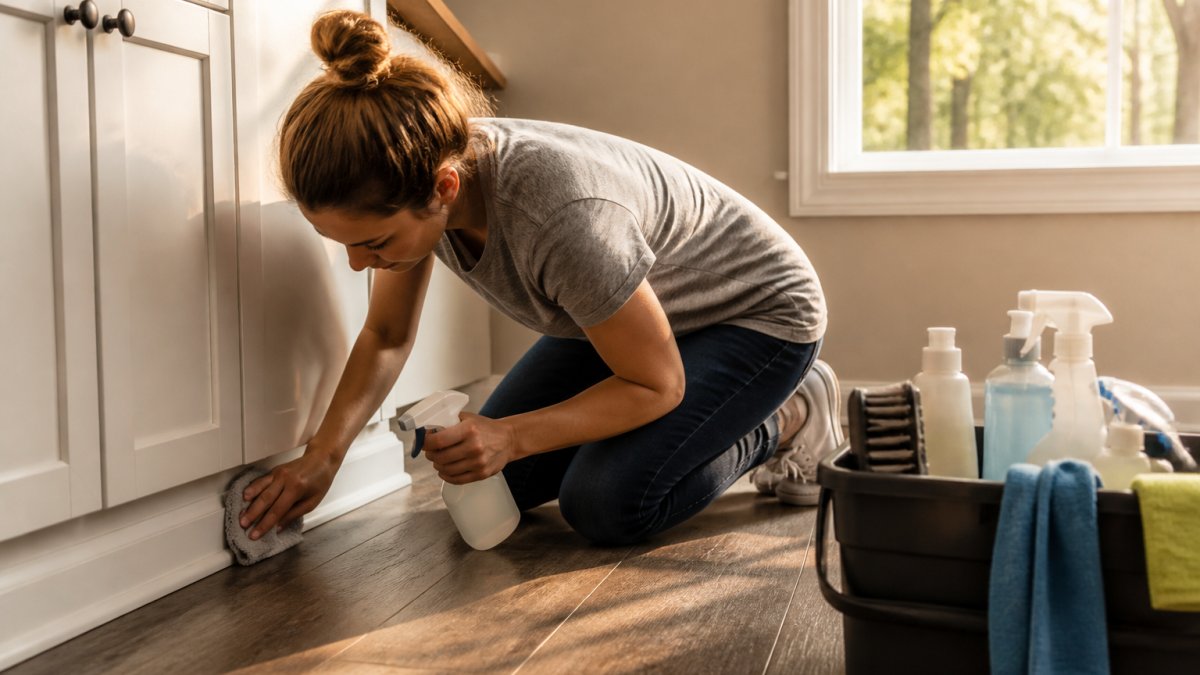
Work one room fully before moving to the next. Partial cleaning across multiple rooms leaves you with a house that looks untouched and a to-do list that never shrinks.
Kitchen Deep Cleaning Checklist
The kitchen carries the heaviest grease and food residue load in the house, so it deserves the most time. Budget 60-90 minutes for a thorough pass.
- Empty the refrigerator, discard expired food, and wipe every shelf and drawer.
- Pull the refrigerator and stove away from the wall and clean behind both.
- Run the oven's self-clean cycle or scrub it by hand with a degreaser.
- Wipe cabinet fronts, handles, and the range hood filter.
- Scrub the backsplash, sink, and faucet base, including the seam where the sink meets the counter.
- Clear and wipe the microwave, inside and out.
- Sweep and mop the floor, including under the appliances.
Bathroom Deep Cleaning Checklist
Bathrooms reward a methodical approach because grout, caulk, and glass all fail differently. Plan 45-60 minutes per bathroom.
- Spray the shower, tub, and toilet with cleaner and let it sit while you work elsewhere in the room.
- Scrub grout lines with a stiff brush and a dedicated grout cleaner.
- Wash the shower curtain or liner, or wipe glass doors with a squeegee and glass cleaner.
- Clean the toilet inside and out, including the base and the bolts.
- Wipe mirrors, vanity, and cabinet fronts.
- Launder or replace bath mats and towels.
- Mop the floor last, working from the far corner toward the door.
Bedroom Deep Cleaning Checklist
Bedrooms collect dust in places that are easy to forget: under the bed, behind the headboard, and on top of ceiling fans.
- Strip the bed and wash bedding, including the mattress pad and pillow covers.
- Vacuum the mattress on both sides.
- Dust ceiling fans, light fixtures, and the tops of picture frames.
- Wipe down nightstands, dressers, and the headboard.
- Vacuum under the bed and along the baseboards.
- Clean windows, blinds, and curtains.
- Vacuum or mop the floor, moving furniture to reach the edges.
Living Room and Common Area Deep Cleaning Tasks
Common areas take the most daily abuse and show it first.
Start with decluttering. Piles of mail, toys, and stray items make every other task harder. Once surfaces are clear, dust from the top down: ceiling fan, shelves, electronics, then furniture.
Hard floors benefit from a two-pass approach: vacuum or sweep first to remove debris, then mop. Skipping the first pass just smears dirt around.
Dusting, Vacuuming, and Hard-to-Reach Areas Most People Skip
The tasks that separate a good deep clean from a great one are almost always the ones nobody sees. These are the spots that quietly degrade indoor air quality and make a home feel less clean than it looks:
- Tops of ceiling fans, light fixtures, and cabinet uppers
- Behind and beneath the refrigerator and stove
- Window tracks, blinds, and the tops of curtain rods
A extendable duster with a bendable head handles most of the high work without a ladder. For vents, remove the cover and vacuum the grille on both sides.
Weekly House Cleaning Checklist: Keeping Up Between Deep Cleans
A weekly house cleaning checklist prevents buildup from ever reaching deep-clean levels. The goal is not perfection; it is preventing the compounding that turns a small task into a big one.
| Day | Focus Area | Time Estimate |
|---|---|---|
| Monday | Kitchen counters, sink, and floor | 20 minutes |
| Tuesday | Bathrooms: toilets, sinks, mirrors | 20 minutes |
| Wednesday | Vacuum high-traffic floors | 25 minutes |
| Thursday | Dust surfaces and wipe high-touch points | 15 minutes |
| Friday | Bedrooms: bedding, nightstands, floors | 20 minutes |
| Saturday | Common areas and entryway | 30 minutes |
| Sunday | Rest or catch up on one missed task | 0-20 minutes |
This schedule keeps weekly chores realistic. If a task slips, it rolls into Sunday rather than piling up.
Daily Chores, Weekly Chores, and Monthly Chores: Building a Cleaning Schedule
A cleaning schedule works when daily chores take minutes, not hours. The structure most households find sustainable breaks down like this:
- Daily chores: Make beds, wipe kitchen counters, do dishes, sweep the kitchen floor, tidy common areas.
- Weekly chores: Vacuum, mop, clean bathrooms, change bedding, dust surfaces, take out recycling.
- Monthly chores: Clean inside the oven and microwave, wash windows, dust blinds and vents, clean behind appliances, wipe cabinet fronts.
The mistake is treating monthly tasks as optional. They are the bridge between weekly maintenance and a full deep clean. Skip them for three months and you have effectively scheduled a deep clean whether you wanted one or not.
For households that would rather not manage this themselves, Top Royal Cleaners offers recurring service that keeps the weekly and monthly tiers handled without the mental load.
A Time-Based Plan for Completing a Deep Clean in One Day
Most checklists tell you what to clean but not how long it takes or what to do when the day runs short. This plan fixes that. It is built for a typical three-bedroom, two-bath home of roughly 1,500-2,000 square feet, assumes one person working steadily with supplies already gathered, and uses the top-down, back-to-front order that prevents rework.
Realistic Time Estimates by Zone
| Zone | Time (one person) | Time (two people) |
|---|---|---|
| Declutter and supply setup | 30-45 min | 20-30 min |
| Kitchen (appliances, cabinets, floors) | 90-120 min | 50-70 min |
| Bathrooms (each) | 45-60 min | 25-35 min |
| Bedrooms (each) | 30-40 min | 20-25 min |
| Living room and common areas | 60-75 min | 35-45 min |
| High dusting, vents, baseboards (whole home) | 45-60 min | 25-35 min |
| Final floor pass and trash removal | 30-45 min | 20-30 min |
Add it up and a full single-day deep clean lands around 6-8 hours for one person. That is a long day, not a casual afternoon, which is why the order below matters.
The Order That Prevents Rework
- Declutter first, everywhere. Piles of mail, toys, and stray items block every surface you need to reach. Spend 30-45 minutes walking the home with a laundry basket and a trash bag. Do not start cleaning until surfaces are clear.
- Set up supplies in one central spot. A caddy or bucket with your cloths, sprays, brushes, and vacuum attachments saves dozens of trips and keeps you from hunting for a tool mid-task.
- Work top to bottom in each room. Ceiling fans and light fixtures first, then shelves and furniture, then counters, then floors. Dust falls, so cleaning the floor before the ceiling fan means doing the floor twice.
- Work back to front toward the door. You finish at the exit instead of walking back across a wet floor.
- Do dry tasks before wet tasks. Vacuum and dust before you mop or wipe, or you will smear debris into a wet surface.
- Save the final floor pass for last. After all the dusting and high work, one vacuum-and-mop pass across the whole home catches everything that settled.
A One-Day Schedule You Can Actually Follow
- 7:00-7:45 a.m., Declutter every room; stage supplies in one spot.
- 7:45-9:45 a.m., Kitchen: empty and wipe the refrigerator, pull the fridge and stove out, clean behind both, run or hand-scrub the oven, wipe cabinet fronts and the range hood filter, scrub the sink and backsplash, then sweep and mop.
- 9:45-10:00 a.m., Break. Open windows and step outside for fresh air.
If You Only Have a Few Hours
Prioritize by visible impact per minute spent. The kitchen and bathrooms deliver the biggest perceived difference, followed by floors and high-touch surfaces. High dusting and baseboards are the most commonly skipped tasks, but they are also the least visible, so they are the first to cut when time is short. A common pattern is to handle the kitchen and bathrooms in one session and schedule the rest of the home for a second day.
The Multi-Day Alternative
If a single day is not realistic, split the work across three sessions and keep the same top-down order within each room:
- Day 1: Declutter, kitchen, and bathrooms.
- Day 2: Bedrooms and living areas, including upholstery and rugs.
- Day 3: Whole-home high dusting, vents, baseboards, and the final floor pass.
Spreading the work also reduces the physical strain of a single long push, which matters for anyone with back, knee, or shoulder limitations. The trade-off is that dust resettles between sessions, so plan the high dusting for the last day rather than the first.
Safety, Product Compatibility, and Ventilation During Deep Cleaning
Deep cleaning concentrates more chemicals in a shorter window than routine cleaning, so ventilation is not optional. Open windows, run exhaust fans, and take breaks in fresh air when working with strong products.
The EPA's guidance on safe cleaning product use recommends never mixing cleaning products unless the label explicitly says to, and storing them out of reach of children and pets.
Other safety basics:
- Wear gloves and eye protection when scrubbing grout or using degreasers.
- Never use a stiff brush on stainless steel, glass, or nonstick surfaces.
- Test any new product on a hidden area first.
Cleaning by Surface Material: What Works and What Damages
Cleaning by surface material prevents the most expensive mistake in deep cleaning: damaging a finish while trying to clean it. The right product on the wrong surface can etch glass, dull stone, strip a sealant, or leave permanent water rings. The table below is a starting point, but the mechanism behind each rule is what lets you make the right call on a surface that is not listed.
Why the Wrong Product Damages a Surface
- Acids etch calcium-based materials. Vinegar, lemon juice, and many bathroom cleaners dissolve the calcium carbonate in marble, travertine, limestone, and grout. The result is a dull, permanently etched spot that no amount of scrubbing fixes.
- Alkaline cleaners strip oils and sealants. Degreasers and ammonia-based products cut grease well, but they also strip the wax or polymer sealant on hardwood, laminate, and some stone, leaving the surface unprotected and more prone to staining.
- Abrasives scratch soft finishes. Scouring pads, wire brushes, and gritty powders leave micro-scratches on stainless steel, glass, and nonstick coatings. Scratches trap dirt and make the next cleaning harder.
Surface-by-Surface Guide
| Surface | Safe Approach | Avoid | Why |
|---|---|---|---|
| Granite or quartz | pH-neutral cleaner, soft microfiber | Vinegar, acidic cleaners | Acid dulls the finish and can etch sealed stone |
| Marble, travertine, limestone | Stone-specific pH-neutral cleaner | Anything acidic, including many bathroom sprays | Calcium-based stone dissolves on contact with acid |
| Stainless steel | Wipe with the grain using a specialty cleaner | Abrasive pads, bleach, steel wool | Abrasives scratch; bleach can pit the surface |
| Glass and mirrors | Glass cleaner, microfiber cloth | Paper towels, ammonia on tinted or filmed glass | Paper towels leave lint and micro-scratches; ammonia can cloud films |
| Hardwood | Damp (not wet) microfiber, wood-safe cleaner | Soaking, steam mops, all-purpose sprays | Water swells seams; steam can lift finish |
| Laminate | Damp cloth, mild soap | Excess water at seams, abrasive pads | Water swells the core at seams; abrasives dull the wear layer |
| Tile and grout | Grout brush, oxygen bleach, warm water | Wire brushes, harsh acids on colored grout | Wire brushes erode grout; acids can fade color |
| Natural stone (sealed) | Stone cleaner, reseal per manufacturer schedule | Acidic or alkaline cleaners that strip sealer | Sealer wears off and the stone stains |
| Copper and brass | Mild soap, soft cloth, specialty polish | Ammonia, abrasive pads | Ammonia discolors; abrasives remove patina unevenly |
| Upholstery | Vacuum first, then fabric-appropriate cleaner | Saturating the fabric, generic all-purpose spray | Over-wetting causes mildew and ring marks |
Dilution, Dwell Time, and Testing
Product concentration and how long a cleaner sits matter as much as which product you pick. A few practical rules:
- Follow the label dilution. More concentrated is not stronger in a useful way; it often leaves residue that attracts dirt faster.
- Respect dwell time. Most cleaners need 1-5 minutes to break down soil. Spraying and immediately wiping wastes product and effort. Let it sit, then agitate.
- Test in a hidden spot first. Try any new product on an inconspicuous area, wait a few minutes, and check for dulling, discoloration, or finish removal before using it broadly.
Sealing and Protecting After the Clean
Deep cleaning is also the right time to check whether a surface needs protection. Sealed stone, grout, and some wood floors benefit from resealing on a schedule the manufacturer or installer specifies, often every 6-12 months for high-use areas. A simple water test helps: if water beads on stone or grout, the sealer is still working; if it soaks in and darkens the surface, it is time to reseal.
Accessibility and Household Adaptations: Pets, Kids, and Limited Mobility
Not every household can follow the same checklist, and that is fine. Adapt the plan to the people and animals who live there.
For pet owners, prioritize dander control: vacuum upholstery and rugs more often, wash pet bedding weekly, and use a vacuum with a HEPA filter.
For households with young children, keep cleaning products locked away and clean high-touch surfaces like toys, doorknobs, and light switches more often.
When to Call a Professional Cleaning Service
A professional deep clean makes sense when the task exceeds the time or physical capacity you have available. Common triggers include moving in or out, post-construction dust, hosting an event, recovering from illness, or simply reaching a point where the backlog is too large to tackle in a weekend.
Professional teams also bring equipment most homes do not own, like commercial-grade vacuums and extractors for upholstery and carpet. For post-construction cleanup, the fine drywall dust that settles into every surface requires a level of detail that is difficult to replicate with household tools.
Top Royal Cleaners has served homes and businesses across Montgomery County and Pottstown Pennsylvania for over 15 years, and every job is handled by a fully licensed and insured team.
Conclusion: Making Your Deep Cleaning Checklist Work Long-Term
The challenge with any deep cleaning checklist is that it only works if you actually use it, and most people abandon the plan after the first attempt because they tried to do everything at once. The fix is to treat deep cleaning as a rotating system rather than a single event: one room or one zone per week, backed by a consistent weekly routine.
If the schedule keeps slipping, that is usually a sign the workload is bigger than the time available, not a sign of failure. Top Royal Cleaners handles recurring housekeeping, deep cleans, and post-construction work with a licensed, insured, pet-friendly team, and first-time customers receive 20% off. Get a Quote and let us take the checklist off your hands.
Frequently Asked Questions
What is done during a deep cleaning of a house?
A deep clean goes beyond surface tidying to address buildup in hard-to-reach areas. Typical tasks include scrubbing grout, wiping baseboards, cleaning inside appliances, washing window tracks, dusting ceiling fans and light fixtures, and disinfecting high-touch surfaces. Unlike routine cleaning, a deep clean also covers areas behind and under furniture, inside cabinets, and along edges where dust and grime collect over months. Most homes need three to six hours depending on size and condition.
What should I include in my weekly house cleaning checklist?
A weekly house cleaning checklist should cover the tasks that keep a home livable between deep cleans: vacuuming carpets and rugs, mopping hard floors, wiping countertops and backsplashes, cleaning sinks and toilets, taking out trash, and dusting visible surfaces. Add changing bed linens and wiping high-touch surfaces like light switches and door handles. These weekly chores prevent buildup so your next deep clean takes less time and effort.
How often should you deep clean your home?
Most homes benefit from a deep clean every three to six months. Households with pets, allergy sufferers, young children, or high foot traffic may need one every two to three months. If you follow a consistent weekly cleaning routine, you can stretch deep cleans to twice a year. Seasonal changes, like spring cleaning, are a natural trigger to reset the whole house.
What supplies do you need for a deep clean?
A basic deep cleaning supplies list includes microfiber cloths, a microfiber mop, a vacuum with attachments, a scrub brush, an old toothbrush for grout, rubber gloves, all-purpose cleaner, glass cleaner, disinfectant, and a degreaser for kitchen surfaces. Add a bucket, a squeegee for windows, and trash bags. Match products to your surface materials to avoid damage, and always check labels before using a cleaner on stone, wood, or delicate finishes.
Where should you start when deep cleaning a house?
Start at the top of each room and work downward. Dust ceiling fans, light fixtures, and upper shelves first so debris falls onto surfaces you will clean later. Then move to mid-level areas like countertops and furniture, and finish with floors. Work room by room rather than jumping around, and begin with the dirtiest spaces, usually the kitchen and bathrooms, while you have the most energy.
Is it worth hiring a professional cleaning service for deep cleaning?
Hiring a professional makes sense when a deep clean would take more time than you have, when you lack the right tools for tasks like carpet extraction or high-reach dusting, or when health concerns require thorough disinfection. A licensed and insured service also brings consistency, so nothing gets missed. For homes in the Pottstown and Montgomery County area, requesting a quote helps you compare the cost against the hours you would spend doing it yourself.
CDC guidance on cleaning and disinfecting homes