 ultimate-guide
House Cleaning Frequency Guide for 2026
Quick Summary
Most homes need daily wipe-downs of kitchen counters and sinks, weekly floor vacuuming, bathroom cleaning and bedding washes, and monthly passes on the fridge, cabinets and windows. Pets, allergies, kids and cooking habits can shorten these intervals, so the cleaning frequency for your house should be adjusted to match your household.
- Wipe kitchen counters and the stovetop after cooking, every day.
- Vacuum floors and rugs weekly, sooner with shedding pets or kids.
- Clean bathroom fixtures and tub or shower weekly to limit soap scum.
- Wash bedding weekly, more often for allergies or pets on the bed.
- Clean the refrigerator interior and descale the coffee maker monthly.
Table of Contents
- How Often Should You Clean Your House? A Frequency Framework
- Daily Cleaning Tasks and Quick Resets That Keep Clutter Down
- Weekly and Monthly Cleaning Schedule: Building a Daily Weekly Monthly Routine
- House Cleaning Checklist by Room: Kitchen, Bathroom, Bedroom, and Living Areas
- How Often to Deep Clean a House: Seasonal and Yearly Tasks
- How Long Does It Take to Clean a House? Time Blocks by Household Size
- Adjusting Your Cleaning Frequency for Pets, Allergies, and Short-Staffed Weeks
- Booking Help for the Tasks You Don't Have Time For
- Frequently Asked Questions
How Often Should You Clean Your House? A Frequency Framework
Last Updated: October 27, 2026
Most homeowners clean on instinct: the kitchen gets attention every few days while the baseboards go untouched for a year. A house cleaning frequency guide for 2026 should replace guesswork with a framework, so you know which tasks need daily attention, which need weekly passes, and which can wait for a seasonal reset.
Cleaning frequency is the interval at which a given task needs to be repeated to keep a space hygienic and presentable. Tasks that touch food, bodies, or high-traffic surfaces need short intervals. Tasks that address dust buildup or soil that accumulates slowly can run on longer ones.
Four factors shift those intervals for most households: how many people live there, whether pets shed or track in dirt, whether anyone has allergies or asthma, and how much foot traffic the floors take. Adjust the framework below to match your house, not a generic average.
Daily Cleaning Tasks and Quick Resets That Keep Clutter Down
Daily cleaning is about containment, not perfection. The goal is to stop small messes from compounding into weekend projects.
A daily routine can cover:
- Wiping kitchen counters and the stovetop after cooking
- Loading or emptying the dishwasher so dishes do not pile up in the sink
- Putting shoes, bags, and mail in their assigned spots
- Wiping bathroom sinks and checking the toilet
- Making beds, which keeps bedrooms feeling reset even when nothing else gets done
A daily reset can help keep clutter from building up. Pick a time and move through the main living spaces with a laundry basket, returning anything that belongs elsewhere.
Weekly and Monthly Cleaning Schedule: Building a Daily Weekly Monthly Routine
Weekly and monthly tasks can be organized by household needs. The table below gives a starting interval for each task and signals to move it up or push it back.
| Task | Starting interval | Why this interval | Do it sooner if... | It can wait if... |
|---|---|---|---|---|
| Vacuum floors and rugs | Weekly | Soil and grit abrade carpet fibers and scratch hard floors; visible dust returns within days in traffic lanes | You have shedding pets, kids, or outdoor shoes worn indoors | Rooms are unused and shoes are removed at the door |
| Mop hard floors | Weekly | Mopping removes the film that vacuuming leaves behind; over-mopping dulls finish and grout | Kitchen or entry floors feel tacky or show footprints | You spot-clean spills and the floor passes the barefoot test |
| Clean bathroom fixtures and tub/shower | Weekly | Soap scum and body oils harden over days; weekly cleaning keeps biofilm from establishing | Multiple users, high humidity, or visible pink/black film | The bathroom is a guest bath used rarely |
| Wash bedding and change sheets | Weekly | Skin cells, sweat, and dust mites accumulate; weekly hot-water washing is the common recommendation for mite-sensitive households | Allergies, pets on the bed, illness, or night sweats | You use a washable mattress protector and shower before bed |
| Dust furniture and electronics | Weekly | Dust is a mix of skin cells, fibers, and outdoor particles; damp-dusting weekly keeps it from becoming airborne | Allergies, open windows, or forced-air heating season | You dust with a damp microfiber cloth and the surface passes the white-glove test |
| Empty trash and wipe the can | Weekly | Residue and odor build in the can even with a liner; a wipe-down prevents pests and smells | Kitchen waste includes food scraps or the can sits in sun | The can holds dry recyclables only |
| Clean the inside of the refrigerator | Monthly | Spills and expired food accumulate slowly; a monthly pass prevents odor and cross-contamination | You see condensation, odor, or spoiled produce | You wipe spills as they happen and the fridge is nearly empty |
| Wipe cabinet fronts and handles | Monthly | Grease and hand oils build a film that attracts dust and dulls finishes | Kitchen is used daily for frying or baking | Cabinets are high-gloss and wiped weekly with a damp cloth |
| Descale the coffee maker | Monthly | Mineral scale insulates the heating element and slows brewing; monthly descaling protects the machine | You have hard water or brew daily | You use filtered water and brew a few times a week |
| Wash windows and mirrors | Monthly | Fingerprints and film build on glass; monthly cleaning keeps them from hazing | Kids, pets, or glass doors touched often | Windows are rarely touched and you clean them seasonally |
| Check smoke and carbon monoxide detector batteries | Monthly test, annual replace | Testing monthly catches dead batteries; replacing annually is the common manufacturer recommendation | The chirp starts or the test fails | Never skip the monthly test |
A simple structure for the three levels looks like this:
- Daily: surface wipe-downs, dishes, quick tidy
- Weekly: floors, bathrooms, bedding, dusting
- Monthly: appliance interiors, cabinet fronts, windows, filters
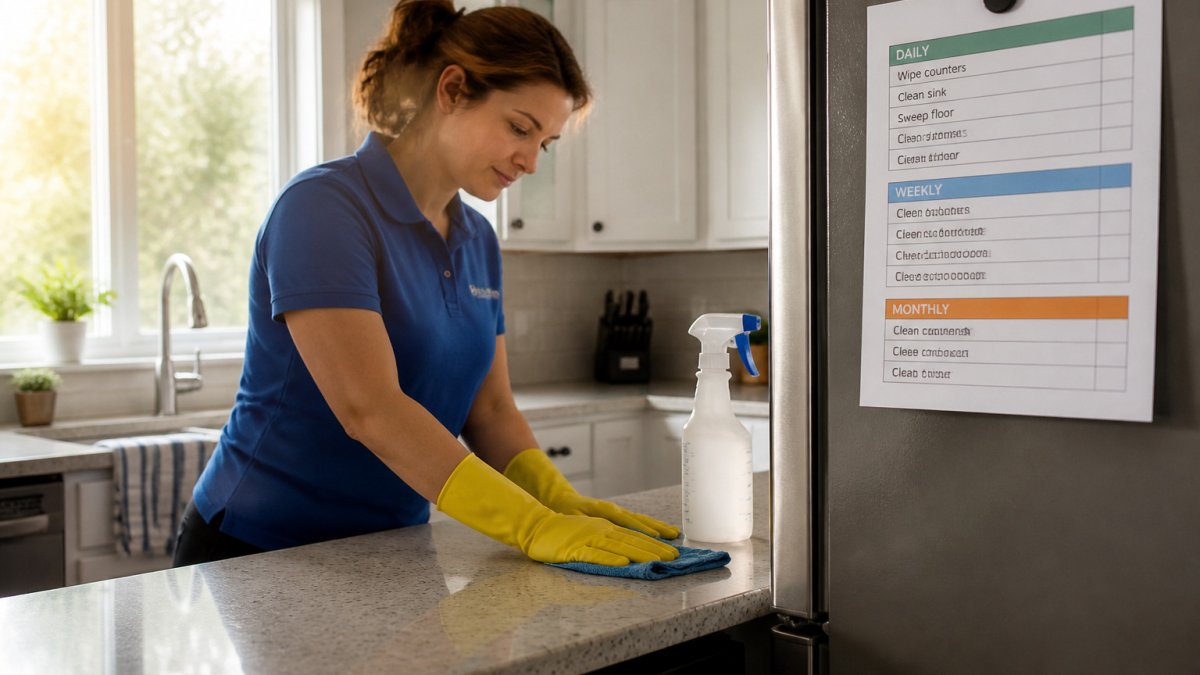
Assign weekly tasks to fixed days, vacuuming Saturday, bathrooms Wednesday, linens Sunday, to spread the work out. A printed cleaning calendar on the fridge is one way to keep track of tasks.
House Cleaning Checklist by Room: Kitchen, Bathroom, Bedroom, and Living Areas
Room-by-room checklists help you cover ground systematically. Use them as a starting point and adjust the frequency for your household.
Kitchen
- Daily: counters, stovetop, sink, dishes
- Weekly: microwave interior, cutting boards, floor
- Monthly: refrigerator shelves, oven interior, range hood filter
Bathroom
- Daily: sink, toilet exterior, mirror spot-clean
- Weekly: toilet, tub or shower, floor, towels
- Monthly: grout scrub, exhaust fan cover, cabinet fronts
Bedroom
- Daily: make the bed, clear surfaces
- Weekly: change sheets, dust, vacuum or sweep
- Monthly: flip or rotate the mattress if applicable, clean under the bed, wash curtains as needed
Living Areas
- Daily: fluff pillows, clear coffee tables, quick vacuum of high-traffic zones
- Weekly: dust, vacuum upholstery, clean glass surfaces
- Monthly: wipe baseboards, clean light switches and door frames, check air vents
High-touch surfaces such as light switches, door handles, remote controls, and faucets can be included in a household cleaning routine.
How Often to Deep Clean a House: Seasonal and Yearly Tasks
Deep cleaning can be organized into quarterly and annual blocks.
Quarterly deep-clean tasks include washing windows inside and out, cleaning window tracks, shampooing carpets or rugs, wiping down ceiling fans, and cleaning dryer vents.
Annual tasks include cleaning gutters, pressure-washing exterior surfaces, deep-cleaning the oven and refrigerator coils, servicing HVAC filters and ducts, cleaning out closets and donating unused items, and inspecting caulking and grout.
How Long Does It Take to Clean a House? Time Blocks by Household Size
Time requirements depend on home size, number of occupants, and how often you clean.
Adjusting Your Cleaning Frequency for Pets, Allergies, and Short-Staffed Weeks
Households differ. Use the modifiers below as a starting point, then adjust intervals to your conditions.
Pets.
Children.
Allergies and asthma.
Household size and foot traffic.
Cooking habits.
Short-staffed weeks.
Booking Help for the Tasks You Don't Have Time For
Some tasks, such as deep cleaning, post-construction cleanup, or recurring housekeeping, can be handed off. Top Royal Cleaners provides residential and commercial cleaning services in Montgomery County and Pottstown, Pennsylvania. Our team is fully licensed and insured.
When you are ready, you can request a quote from Top Royal Cleaners.
Frequently Asked Questions
How often should you clean your house?
Most households do best with a daily reset of about 10 to 15 minutes, a weekly pass through bathrooms, kitchen, floors, and dusting, and a monthly round of tasks such as washing baseboards, cleaning appliance fronts, and wiping light switches. Deep cleaning is usually spread across the year rather than done all at once. Households with pets, allergies, or heavy foot traffic typically need the weekly tasks more often, while a quiet home with few occupants may stretch some monthly tasks to every six weeks.
What should be cleaned daily, weekly, and monthly?
Daily tasks include making beds, clearing dishes, wiping kitchen counters, and a quick tidy of high-traffic areas. Weekly tasks cover vacuuming, mopping, cleaning bathrooms, dusting, and changing bedding. Monthly tasks include cleaning inside the microwave, wiping cabinet fronts, washing trash cans, and checking air filters. Matching these intervals to your household's actual use keeps the schedule realistic.
How often should you wash bedding and towels?
Sheets and pillowcases are generally washed weekly, especially for people who sleep with pets or have allergies. Bath towels are usually washed every three to four days, and hand towels and kitchen towels more often. Comforters, duvets, and mattress protectors can be washed every one to three months depending on use. Washing in hot water when the care label allows helps reduce dust mites and allergens.
How long does it take to clean a house?
A two- to three-bedroom home usually takes about two to four hours for a full weekly clean by one person, while a deep clean can take a full day or more. Time depends on square footage, number of occupants, pets, and how often tasks are done. Breaking chores into time blocks, such as one room per evening, makes the total workload easier to manage without a single exhausting session.
How do you make a realistic cleaning schedule?
Start by listing every task and how often it needs doing, then assign tasks to days based on your available time. Keep daily tasks under 15 minutes, put heavier weekly work on one or two set days, and reserve one weekend slot each month for monthly tasks. Print the schedule or keep it on a shared calendar so everyone in the household can see their assignments.
How often should you deep clean each room?
Kitchens benefit from a deep clean every three months, including cabinet interiors, oven, and behind appliances. Bathrooms usually need a deep clean monthly, with grout and fixtures addressed quarterly. Bedrooms and living rooms can be deep cleaned twice a year, covering window tracks, upholstery, and baseboards. Seasonal changes such as spring are a common time to schedule these tasks.
Does Top Royal Cleaners handle pet hair in homes?
Yes. Top Royal Cleaners offers pet-friendly cleaning for homes in Montgomery County and Pottstown, Pennsylvania. Visit the Top Royal Cleaners website for current prices or to request a quote.